

So you’ve established a good discipline of reading the bible, but what about taking your reading a little further?
4. Studying
To study the bible is to take your reading and dig a little deeper to further your understanding. So where do you even start?
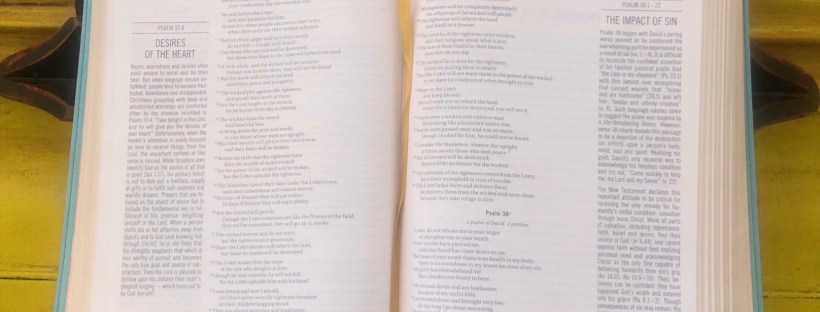
First of all, getting yourself a good study bible is super helpful. These typically contain footnotes, references and simple commentaries that will definitely point you in the right direction. There’s a lot to choose from, but totally worth exploring online to see which one is suitable for you.
I’ve used both the NIV Study Bible and the ESV Study Bible – both are fab.
With that checked off the list, there’s a few options out there for what to study. Remember – this part is not a read through, it’s choosing something to look at in a deeper way.
You might what to look at the following:
Character Study
The Bible is filled with the stories of ordinary people who God used to shape His world. An overview of them leaves no life experience left out – it really does cover a lot of ground.
Maybe you have some stories you love, or people you identify with because of what they journeyed. Reading round their entire story will help paint a better picture.
So take David for example – you’ll read about him mainly in Samuel, Kings and little in Chronicles. David also penned a good portion of the Psalms. So studying those books will help shape and start a good study of David.
There are so many great people to look at: Abraham & Sarah, Moses, Joshua, Elijah, Elisha, Esther, Ruth, the Apostle Paul, Peter….. the list could go on. Just pick one and enjoy seeing how God transformed their life and used them in a remarkable way.
If He can do it with them, He can do it with you.
Themes
Perhaps looking at a certain topic seems a good option for you. Maybe looking at peace, or hope, love, forgiveness, dreaming etc …. whatever is going on in your life right now whatever you need you can find in the Bible.
To start studying a theme – go to the back of your bible and look up your particular word/phrase and see what verses it points you to.
Context
Looking into the cultural and historical context of the Bible brings a richness into studying it. Discovering what the world was like, what was going on in history, was was normal practice in that culture can help us understand how the first readers read its pages and understood it.
Even knowing the literary style helps form a deeper understanding.
For example – take the book of Ephesians. It’s a letter to the church in Ephesus, a church that Paul had help plant with Timothy. Do you know what Ephesus was like? Do you know how many Christians lived there? What was the spiritual practices in that place?
Without telling you – this is worth checking out, you’ll discover some epic things doing a background check on these things. In a study bible – the introduction to each book is a good place to start this process.
Word Study
Looking into the original language and its meaning is a great thing to do. For the Old Testament: Hebrew and the New Testament: Greek. There are just not enough English words available to fit what the original text actually says and means – hence why we have so many English translations of the bible.
This will become your favourite thing to do trust me.
So here are 2 sites that are worth checking out: Bible Hub and Blue Letter Bible
Both will let you check out parallel translations. The interlinear feature allows you to see the original translation and gives you access to the Strong’s Concordance which explains that word in detail.
Get your favourite verse – jump on these sites and see just how rich this practice is.
Commentaries and notes from biblical scholars are also featured on these sites and will help guide the whole process.
Enjoy it – it is totally worth your time.
5. Meditating
Memorising and studying scripture involves your head.
Meditation involves your heart.
Memorising and studying scripture involves your head, but meditation involves your heart.
Tweet
Meditating on scripture literally means to read it and then think about it over and over and over again.
It’s engaging in a much deeper way. Thinking about how it applies to you and what it means. It involves taking time to think and slow down.
It’s not about gathering more information, but chewing on information you already have.
Coupling this practice with prayer allows a conversation to form between you and God as you invite the Holy Sprit to help you understand.
Something in this practice moves information from our head to our heart and in this space – we no longer just know stuff, but through the Holy Spirit we begin to experience and encounter the truth.
This is the greatest mystery of all and what makes the Bible a book like no other.
The words in the Bible have the power to transform your life, but only if you read it.
Tweet
The Words in this book will transform your life but only if you read it and engage with it.
 Eyes UP look OUT